Your cart is currently empty!
Survey Says: Planning Your Survey
4 minutes
read
Written by Dr. Vicki Denmark

Dr Vicki Denmark, a K-12 education leader and strategist, brings a powerful blend of expertise. Her deep understanding of classroom needs combines with her proven ability to craft innovative solutions for organizations, including nonprofits and membership associations. Leveraging her extensive experience, Dr. Denmark builds impactful programs that empower educators and strengthen learning communities. Connect with her on LinkedIn to explore how she can support your educational goals.
Using Surveys in Education
Let’s take a look back at the questions one through four I posed in the first installment of this series. For the other questions, please see Survey Says, “Using Surveys in Education,” posted on 5/7/24.
- Why is this survey necessary?
- Is this survey worth the time it will take your respondents to complete it?
- What questions do you have that the survey data will answer?
- How do these questions align to your strategic plan?
It Starts at the Top
If you work in education, you’ve probably lost count of the number of surveys you’ve taken and given over the past three to five years. When you consider how much time you (and other stakeholders) have spent answering or asking, do you think it was all worth it? What improvements were made with the data you collected?
If you believe that the survey responses and end results were, on average, not the best use of time and effort, then it’s probably because they weren’t planned to intentionally align to the organization’s larger goals and objectives.
It’s not easy to come up with money in education, so you should take care to make sure every dollar is spent in clear pursuit of the institution’s larger plan or vision. Why then do we not treat time the same way? Recall from my first post on this topic that even simple surveys can costs tens or hundreds of hours of stakeholders’ time. Shouldn’t you be making sure that every minute you request from them is spent responsibly? And what about your time? I’m sure you’ve gone to analyze a survey at some point only to find the data don’t really answer the questions.
When you begin the survey creation process by reviewing your strategic plan, you are taking the first steps toward this goal. Every dollar you spend should be mapped to an expense, which can be tied to a line item in a budget, which has (hopefully) been aligned to a strategic plan as well). Every survey item should be treated similarly.
Before writing the first item, ask yourself why you even need the survey. What questions do you have about your organization or its members that need answers? Is a survey the best way to get the answers you need? Is it even an appropriate way to get those answers? Are the data you plan to collect worth the time and effort it will take to collect it? Remember, this isn’t just about your time. You need to consider asking people for their time. Wouldn’t you think carefully before asking people for their money? Why should this be different?
After considering these questions, if you still believe the survey is worth creating and administering, your next step should be to consult your strategic planning documents. Take some time and identify which of your goals and objectives your big picture questions align to. When you begin to write the individual survey items, make sure you can map each one to a goal, objective, or an action in the strategic plan.
It takes some time to adjust to this way of approaching surveys, but I promise the efforts are worth it. Although you may not directly observe or feel the results of this process, there are many positives, such as:
- Assurance the surveys are aligned with the strategic plan
- Reduced time requirement from stakeholders (based on eliminating unnecessary items)
- Stakeholder willingness to engage is valued
- Improved ability to make sense of the data (look for the fourth installment in this series for more)
- Use the survey data to support documentation for strategic planning, including for reporting, compliance, and accreditation purposes
Practitioner’s Corner
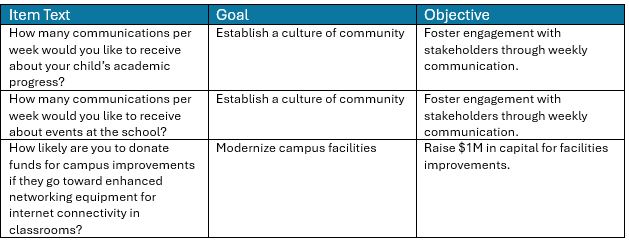
Before building your survey in the tool you’re planning to use to launch it (e.g., Survey Monkey, Google Forms), think about first building a survey blueprint. A survey blueprint is a graphic organizer for ensuring each item on the survey is aligned to one of your strategic goals. If you are having trouble mapping a proposed survey item to your strategic plan, this should be a signal to you rethink including the item on the survey. Certainly, sometimes there are reasons to ask questions that are not directly aligned, but I’ll address that in another post.
Survey blueprints can be rather sophisticated, but you can get started with something like the example below. If you would like to boost your survey effectiveness and want some more guided support, please reach out to me. I’d be happy to discuss how I can help you achieve your goals.
Example of a Survey Blueprint
Leave a Reply